
Yes. Anxiety disorders are diagnosed in children as young as three, though fear and clinginess are normal at this age. What separates a phase from a disorder is duration, intensity, and interference: worry that has lasted months, looks out of proportion to the situation, and is stopping your child from sleeping, eating, or joining in.
Drop off at daycare has turned into a ten minute negotiation. Now she is asking on Sunday night whether tomorrow is a school day. Every toddler goes through clingy stretches, and the question parents actually bring to us is how to tell this stretch from something that needs help.
Is toddler anxiety normal at this age?
Some of it is expected. Fear develops on a predictable schedule in early childhood:
- 8 to 10 months: wariness around unfamiliar people
- 10 to 18 months: separation anxiety, usually at its loudest here
- 2 to 3 years: fear of the dark, loud noises, the bath drain, animals, doctors
- 3 to 5 years: imaginary fears, monsters, being alone in a room, bad dreams
These fears appear, peak, and fade as a child’s thinking matures. A two year old who screams at the vacuum and a four year old who needs the hall light on are both doing something normal. Separation crying at drop off that settles within ten or fifteen minutes after you leave is also normal, which is why daycare staff so often report a completely different child than the one you handed over.
What are the signs of an anxiety disorder in a toddler?
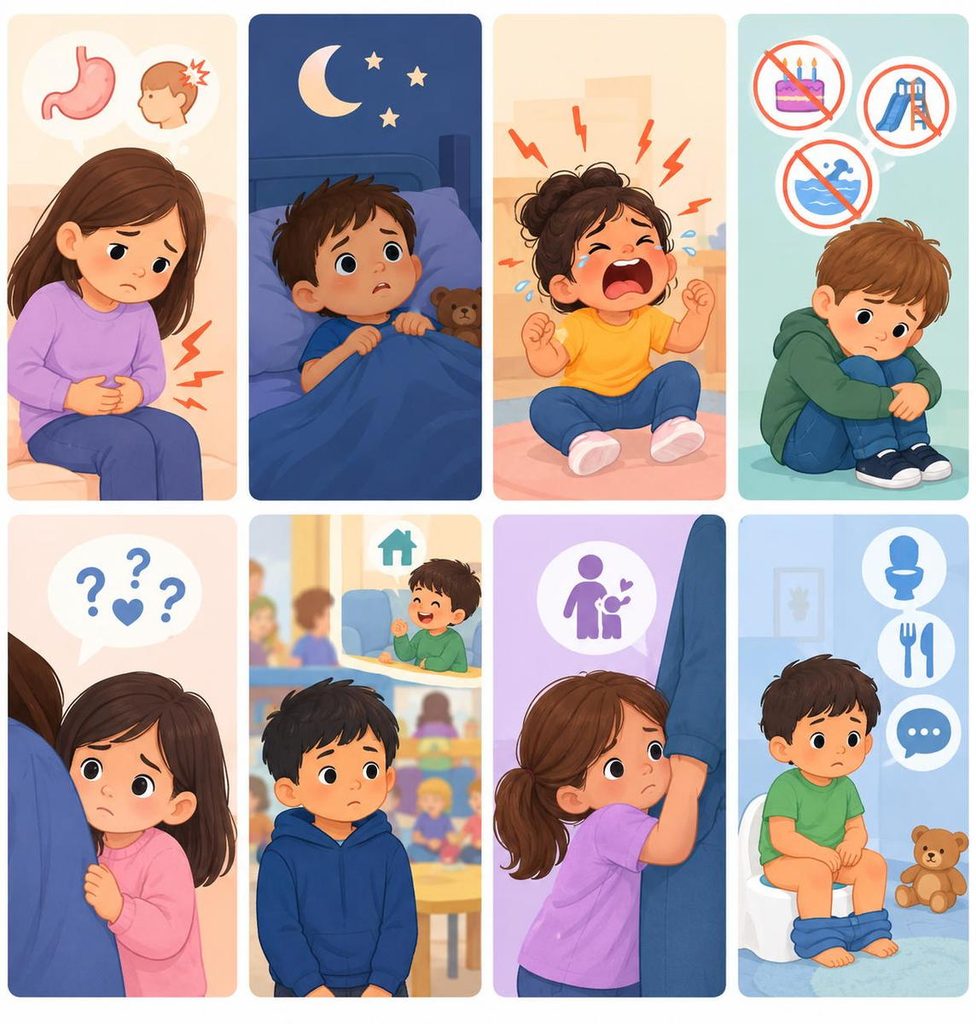
Anxiety at this age rarely sounds like worry. It shows up in the body and in behavior:
- Stomachaches or headaches with no medical cause, especially before daycare or an outing
- Trouble falling asleep, frequent night waking, or refusing to sleep alone after previously managing it
- Meltdowns that are triggered by a specific situation rather than by tiredness or hunger
- Avoiding things most children this age enjoy, such as birthday parties, playgrounds, or the pool
- Constant reassurance seeking, the same question asked over and over
- Freezing or going silent in certain settings while talking normally at home
- Clinging that has intensified rather than eased over several months
- Regression in toileting, feeding, or speech without another explanation
One sign on its own usually means very little. A cluster of them, holding steady for weeks, is worth a conversation.
When does toddler anxiety stop being a phase?
Four questions sort most cases. Pediatricians use roughly the same ones:
- How long? A typical fear lasts days or weeks. Anxiety that meets criteria for a disorder generally persists for months.
- How intense? Is the reaction far larger than the situation calls for, and does it take a long time to come down afterward?
- Is it getting in the way? This is the deciding question. If worry is stopping your child from sleeping, eating, attending daycare, or playing with other children, the label matters less than the interference.
- Is it age appropriate? Stranger wariness at 10 months fits. The same intensity at four does not.
Parents often ask us whether they should wait and see for another few months. If daily life is being reorganized around the fear, waiting is not neutral, because avoidance tends to reinforce the anxiety it was meant to relieve.
What anxiety disorders are diagnosed in young children?
Several are recognized in preschoolers, and diagnosis belongs to a clinician who has evaluated the child:
- Separation anxiety disorder, when distress at separation is severe and persistent well past the usual window
- Specific phobia, an intense fear of one thing such as dogs, needles, or vomiting
- Social anxiety disorder, fear of being watched or judged in social settings
- Selective mutism, consistently not speaking in specific settings such as preschool while speaking freely at home
- Generalized anxiety disorder, broad worry across many everyday situations
Selective mutism is the one most often mistaken for shyness or defiance, and it responds well to early treatment, so it is worth naming to your pediatrician rather than waiting for a child to warm up.
What can I do at home?
Start here while you decide whether to seek an evaluation:
- Name the feeling out loud instead of arguing with it. “You are nervous about the party. That makes sense.”
- Avoid the accommodation trap. Letting your child skip the thing they fear brings relief in the moment and makes the fear larger over time.
- Practice in small steps. Two minutes at the edge of the playground counts as progress.
- Keep routines predictable, especially around bedtime and drop off.
- Make goodbyes short, warm, and identical every day. Long goodbyes raise distress.
- Protect sleep. Overtired toddlers look far more anxious than rested ones.
- Watch what you model. Children read adult tension accurately, even when nothing is said.
Praise the attempt rather than the outcome. A child who walked into the party and stood by the door did the hard part.
When should I talk to our pediatrician about it?
Bring it up at the next well visit if the pattern has held for a month or more, and sooner if any of these apply:
- Your child has stopped eating, sleeping, or attending daycare because of the fear
- There is any self harm, head banging, or talk of not wanting to be alive
- The anxiety followed a specific event such as an accident, a hospital stay, or a loss
- Physical symptoms are frequent enough that you are considering an urgent care visit
- Your family has a history of anxiety, and you are seeing the early version of it
At the visit, our pediatricians take a developmental and behavioral history, rule out medical causes for physical symptoms, and screen for anxiety alongside the usual milestone checks. Bring notes on when the fear shows up, how long episodes last, and what you have already tried, since those details do more for the assessment than a general description of a difficult month.
Frequently asked questions
Will my toddler grow out of it?
Many children do, particularly with everyday fears that fade as thinking matures. Anxiety that already interferes with sleep, eating, or daycare is less likely to resolve on its own, and early support tends to work well at this age because habits are still forming.
Can a three year old actually be diagnosed with anxiety?
Yes. Diagnosis in preschoolers relies on parent and caregiver report, structured observation, and how the child behaves across settings rather than on what the child can explain. That is also why input from daycare or preschool staff is so useful to bring along.
Did I cause this?
No. Anxiety in young children comes from a mix of temperament, genetics, and experience, and a cautious temperament is visible in some babies from the first months. Parents influence how a child learns to handle fear, which is the part that responds to support, not the part to feel guilty about.
Do toddlers take medication for anxiety?
Rarely, and it is not the starting point. First line treatment for this age group is behavioral, often working with the parents as much as the child. If an evaluation by a child mental health specialist is recommended, our affiliate practice Harmonyville provides pediatric anxiety treatment in Mansfield and McKinney, and any question about medication is decided there through a full evaluation, not in advance.
This article is general information based on AAP guidance and is not a substitute for individualized assessment of your child by a licensed clinician. If your child has stopped eating or drinking, is harming themselves, or says they do not want to be alive, call our office or seek emergency care.
Talk to a pediatrician who knows your child
If something has felt off for a few weeks, bring it to a visit rather than waiting for the next scheduled one. Book at kidsvillepeds.com/appointment, or call the office nearest you:
- Mansfield, (682) 341-3910
- Southlake, (682) 345-8010
- McKinney, (469) 885-9400
Tags: Pediatrician Advice, Separation Anxiety, Toddler Anxiety, Preschool Mental Health, Child Behavioral Health, Early Childhood Development


