For most children, the best first doctor for ADHD is their pediatrician. Pediatricians are trained to screen for, diagnose and treat ADHD in kids ages 4 to 18, following American Academy of Pediatrics (AAP) guidelines. If your child’s needs are more complex, your pediatrician can bring in a child psychiatrist, psychologist or developmental-behavioral pediatrician.
The note from school says your child “has trouble staying on task.” Homework takes three hours instead of thirty minutes, and mornings feel like a battle you lose every day. You have searched “ADHD doctor near me” and found psychiatrists, psychologists, neurologists and therapists, and now you are more confused than when you started.
Here is the short version: you do not need to figure out the whole care team on your own. You need one good starting point.
Who Is the Right Doctor for Child ADHD?
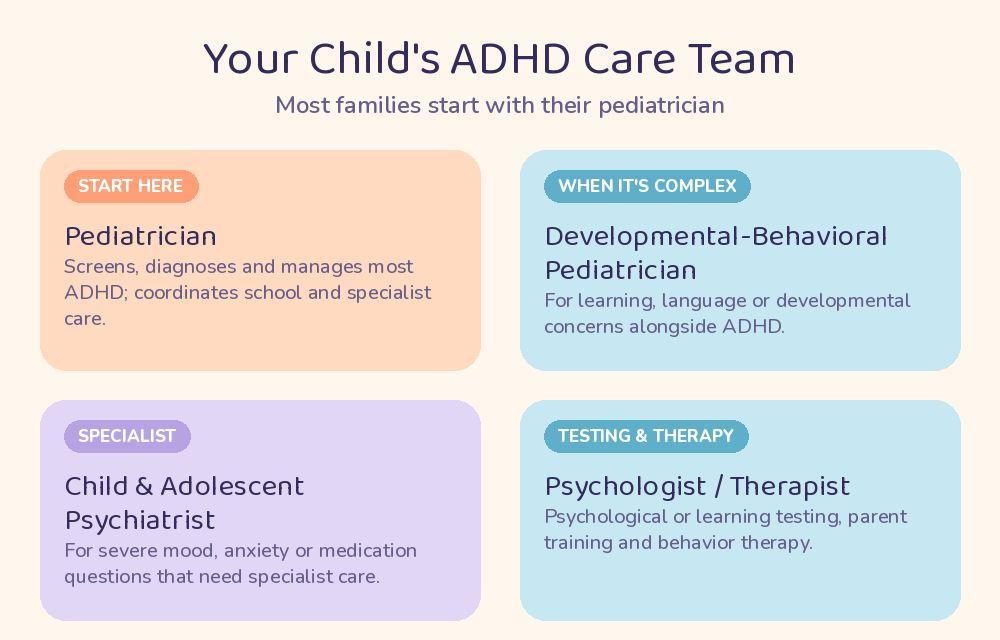
Start with your child’s pediatrician. Then add specialists only if the situation calls for it.
- Pediatrician: Screens, diagnoses and manages most cases of ADHD, including follow-up and coordination with school.
- Developmental-behavioral pediatrician: A pediatric subspecialist for children who also have learning, language, motor or developmental concerns.
- Child and adolescent psychiatrist: A medical doctor specializing in mental health, helpful when ADHD comes with significant anxiety, depression, mood problems or complicated medication needs.
- Child psychologist: Provides in-depth psychological and learning testing, plus parent training and behavior therapy. Psychologists do not prescribe medication in Texas.
- Licensed therapist or counselor: Helps with behavior strategies, coping skills and family support.
- Pediatric neurologist: Usually involved only if seizures, tics or another neurological condition is suspected.
Can a Pediatrician Diagnose ADHD?
Yes. According to the AAP’s guidance for parents on HealthyChildren.org, pediatricians diagnose ADHD in children ages 4 to 18 using standard clinical guidelines. The AAP also describes ADHD as a chronic condition, which is why ongoing care in a medical home matters.
Starting with your pediatrician has real advantages:
- They already know your child. Growth, sleep, hearing, vision and medical history are all in one chart.
- They can rule out look-alikes. Poor sleep, vision or hearing problems, anxiety and learning differences can all mimic ADHD.
- They coordinate care. If a specialist is needed, your pediatrician makes the referral and stays involved.
- Shorter waits. Specialist waitlists can stretch for months, while a pediatric visit can usually be scheduled much sooner.
Parents frequently ask us whether they should “skip straight to a specialist.” In our experience at Kidsville, most families get answers faster by starting with the pediatrician, who can then decide whether specialist input will actually add something.
Learn about well-child visits at Kidsville Pediatrics →
What Happens During a Child’s ADHD Evaluation?
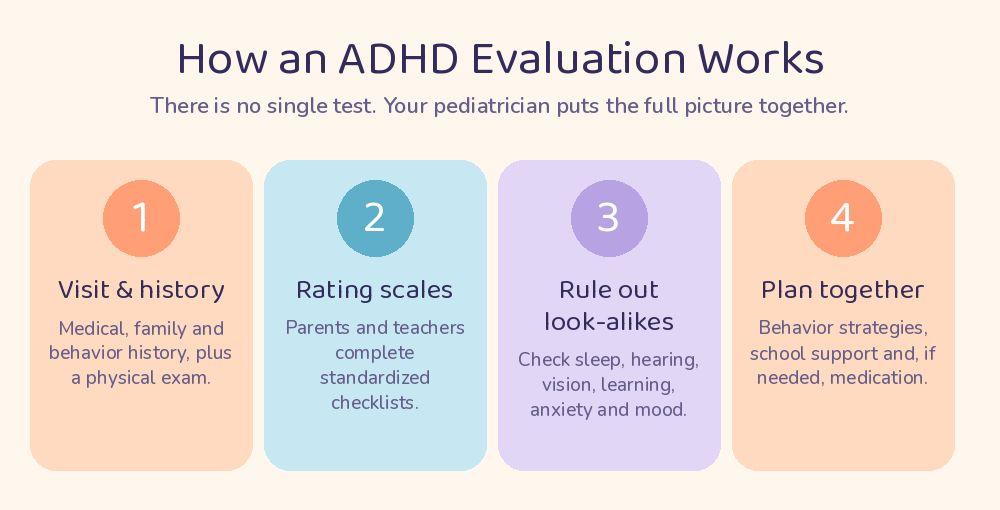
There is no single blood test, brain scan or computer test that confirms ADHD. Instead, the diagnosis comes from putting together information from several people and settings.
- History and exam. Your pediatrician reviews medical, family, developmental and behavioral history and does a physical exam.
- Rating scales. Parents and teachers complete standardized checklists that compare your child’s behavior with other kids the same age.
- Input from school. Report cards, teacher comments and any school testing help show how symptoms affect learning.
- Ruling out other causes. Your pediatrician checks for sleep problems, hearing or vision issues, anxiety, depression and learning disabilities.
- A shared plan. If ADHD is diagnosed, you leave with next steps for home, school and follow-up.
For a diagnosis, symptoms generally need to show up in two or more settings (such as home and school), last longer than six months, begin before age 12 and interfere with daily life.
How can I prepare for my child’s ADHD appointment?
- Write down specific examples of what you are seeing and when it started.
- Bring recent report cards and any notes or emails from teachers.
- Ask your child’s teacher if they are willing to complete a rating form.
- Note family history of ADHD, learning differences, anxiety or depression.
- List your child’s sleep schedule, screen time and any current medications.
When Should My Child See an ADHD Specialist?
Your pediatrician may recommend a specialist when ADHD is not the whole picture. According to the AAP, common reasons for a referral include:
- Learning, speech or developmental delays
- Significant anxiety or depression
- Severe aggression or behavior that puts your child or others at risk
- Possible seizures or a sleep disorder
- A history of trauma
- Symptoms that are not improving with the current treatment plan
Families at Kidsville also have access to psychiatric care through our sister practice, Harmonyville, which offers evaluations and medication management for children and teens.
Explore behavioral health and ADD testing for kids →
How Is ADHD Treated in Children?
Treatment depends on your child’s age and needs, and the plan is built with your family. The AAP’s clinical practice guideline outlines a general approach:
- Preschoolers (ages 4 to 5): Parent training in behavior management is the recommended first step.
- School-age children and teens: A combination of behavior strategies, school supports and, when appropriate, FDA-approved medication.
- Every age: Regular follow-up visits to track progress, side effects and school performance.
Medication is a decision you make together with your child’s doctor. It is not automatic, and doses are always individualized and monitored by a clinician.
Frequently Asked Questions
Do I need a referral to see an ADHD doctor for my child?
It depends on your insurance plan. Many plans require a referral from your pediatrician to see a specialist, which is one more reason to start there.
At what age can a child be diagnosed with ADHD?
The AAP guideline covers children ages 4 to 18. Diagnosis is harder in very young children because behavior changes quickly, so your pediatrician may monitor symptoms over time.
Can my child be tested for ADHD at school?
Schools can evaluate for learning and educational support needs, but a medical diagnosis of ADHD comes from a licensed clinician. School input is still a key part of the evaluation.
Is a psychiatrist better than a pediatrician for ADHD?
Not necessarily. Pediatricians manage most children with ADHD successfully. A psychiatrist is most helpful when there are other mental health conditions or complex medication needs.
Schedule an ADHD Evaluation at Kidsville Pediatrics
If your child’s focus, energy or impulsivity is making school or home harder, you do not have to wait and wonder. Our pediatricians can start the evaluation and help you map out next steps.
Request an appointment online or call the location nearest you:
- Mansfield: (682) 341-3910
- Southlake: (682) 345-8010
- McKinney: (469) 885-9400
This article is for general educational purposes and is not a substitute for an individualized assessment by a licensed clinician. If your child is in crisis or may harm themselves or others, call 911 or the 988 Suicide & Crisis Lifeline right away.Tags: ADHD, Child Development