

The American Academy of Pediatrics advises no screen media before 18 months except video chatting, high-quality co-viewed programming from 18 to 24 months, about one hour a day for ages 2 to 5, and consistent household limits from age 6 on. What matters most is what screens displace: sleep, play, meals, and conversation.
The tablet comes out in the checkout line because it works. Then it’s the car, then dinner, and by Thursday nobody remembers agreeing to any of it. Parents ask us about screen time more than almost any other non-illness topic, and they usually arrive already feeling behind.
Here’s what the guidance actually says, and what we tell families who are trying to apply it in a house that already has screens in it.
What are the AAP screen time guidelines by age?
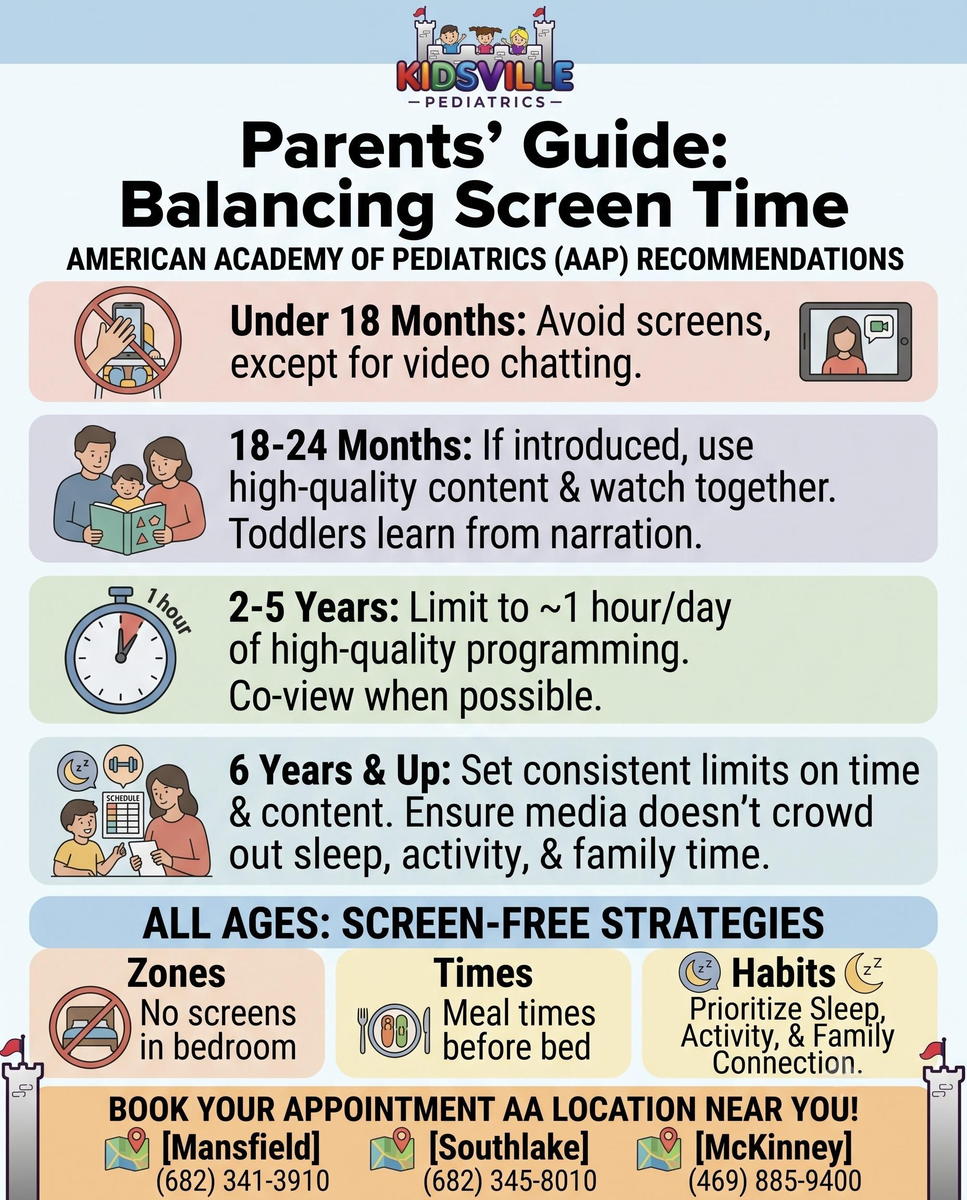
Two things about that table are worth saying out loud.
First, the one-hour figure applies to ages 2 to 5 — not to a 10-year-old. The AAP deliberately stopped issuing a single number for school-age kids and older, because an hour of homework research, an hour of FaceTime with a grandparent, and an hour of autoplay short-form video are not the same hour.
Second, video chatting is carved out at every age. A 14-month-old talking to a grandparent is having a live social interaction, and it isn’t what the “no screens under 18 months” guidance is aimed at.
(AAP / HealthyChildren.org — Family Media Plan)
Does the quality of screen time matter more than the amount?
For most families, yes. Sort your child’s screen time into three buckets:
- Creating and connecting — video calls, making music or art, writing, coding, a shared game with a real person. Highest value
- Actively watching together — a documentary or a show you talk about while it’s on. Good, especially under 5, because your commentary is what makes it learning
- Passive solo scrolling — autoplay video, algorithmic feeds, background TV during meals. Lowest value, and the category that expands quietly
Background TV counts even when nobody is watching. It measurably reduces the amount of talking that happens in a room, which matters most for children under 3 who are building vocabulary from overheard conversation.
In our experience at Kidsville, the families who make the most progress don’t cut total hours first. They swap one bucket for another — the after-school hour moves from a feed to a video call with a cousin — and the total drops on its own a few weeks later.
How do I build a family media plan that actually holds?
Start with the anchors, not the total:
- Pick two screen-free times. Meals and the hour before bed are the highest-yield pair. Screens delay sleep onset and blue-light exposure suppresses melatonin, so this one does double duty
- Pick one screen-free zone. Bedrooms. Charge every device — including yours — somewhere else overnight
- Decide what fills the gap. A rule that removes something without replacing it fails by day four
- Write down what happens when the timer ends. Most screen conflict is about the transition, not the content. A five-minute warning and a fixed stopping point beat a negotiation every time
- Include the adults. Kids calibrate to what they see. This is the hardest line in the plan and the one that changes household behaviour fastest
The AAP’s Family Media Plan tool walks you through this by child and by age, and produces something you can post on the fridge: healthychildren.org Family Media Plan. It takes about ten minutes, and it works better than a rule announced at dinner.
What are the signs screen time has become a problem?
Time on the clock is a weak signal. These are the ones our pediatricians actually ask about:
- Sleep — trouble falling asleep, later bedtime, or a device in the bed
- School — falling grades, unfinished homework, teacher reports of fatigue
- Movement — a drop in outdoor or active play
- Meals and weight — eating in front of a screen, snacking without noticing
- Mood — irritability or distress when devices come away that goes well beyond ordinary frustration
- Friendships — in-person plans being turned down for online ones
- Secrecy — hiding screens, or a sharp change in what your child will show you
One or two of these on a busy week is normal life. Several of them together, holding for more than a few weeks, is worth raising at a visit — screen use is often the visible edge of something else, like anxiety, a sleep problem, or trouble at school.
Frequently asked questions
How much screen time is okay for a 2-year-old?
About one hour a day of high-quality programming, ideally watched with you rather than alone. Video chatting with family doesn’t count toward that hour. Below 18 months, the AAP advises avoiding screen media apart from video calls.
Does screen time cause ADHD?
Research has found associations between heavy early screen use and attention difficulties, but association is not causation, and the direction is unsettled — children who are already more active or less able to focus may also be handed screens more often. Screen time is not an established cause of ADHD. If you’re worried about your child’s attention, ask for a developmental screening rather than adjusting screens and hoping.
Should screens be allowed in the bedroom?
No, at any age. Devices in bedrooms are consistently linked to shorter sleep and later bedtimes, and they remove the parental visibility that makes every other rule enforceable. Charge phones and tablets in a common room overnight, adults included.
My teen needs a phone for school and sports. How do I set limits without a fight?
Shift from total hours to boundaries: no phone at meals, no phone in the bedroom overnight, and a known stopping time on school nights. Teens will negotiate the number of hours indefinitely; they argue far less about a charging spot and a bedtime, because those rules apply to everyone in the house.
This article is general educational information based on AAP guidance and is not a substitute for individualised advice from your child’s pediatrician. If your child is showing signs of depression, self-harm, or a safety concern related to online activity, call our office or seek emergency care right away.
Talk it through at your child’s next visit
Screen time is a standing agenda item at every well-child visit we do — bring what’s actually happening at your house, not the version you think you’re supposed to report. We’ll build a plan around it.
Book online at kidsvillepeds.com/appointment, or call the office nearest you:
- Mansfield — (682) 341-3910
- Southlake — (682) 345-8010
- McKinney — (469) 885-9400
Reviewed against AAP media guidance in August 2026. Refreshed annually.


