

Most childhood constipation is functional — no underlying disease, just a hard stool that hurts once and a child now holding it in. What matters is stool consistency and pain, not the number of days. Call your pediatrician for blood, vomiting, poor growth, soiling accidents, or no improvement after a week.
Your three-year-old has been standing on tiptoe behind the couch for ten minutes, legs stiff, face red, insisting nothing is wrong. It looks like pushing. It’s almost always the opposite.
What counts as constipation at different ages?
Constipation in children is a common problem. Three things, in this order — and frequency is the least important of them:
- Consistency — hard, dry, pellet-like, or unusually wide stools
- Effort and pain — straining, crying, bleeding, or fear of the toilet
- Frequency — fewer than two bowel movements a week, or a sharp drop from your child’s own normal
A child who goes every third day with a soft, easy stool isn’t constipated. A child who goes daily but passes hard pellets and cries doing it is.
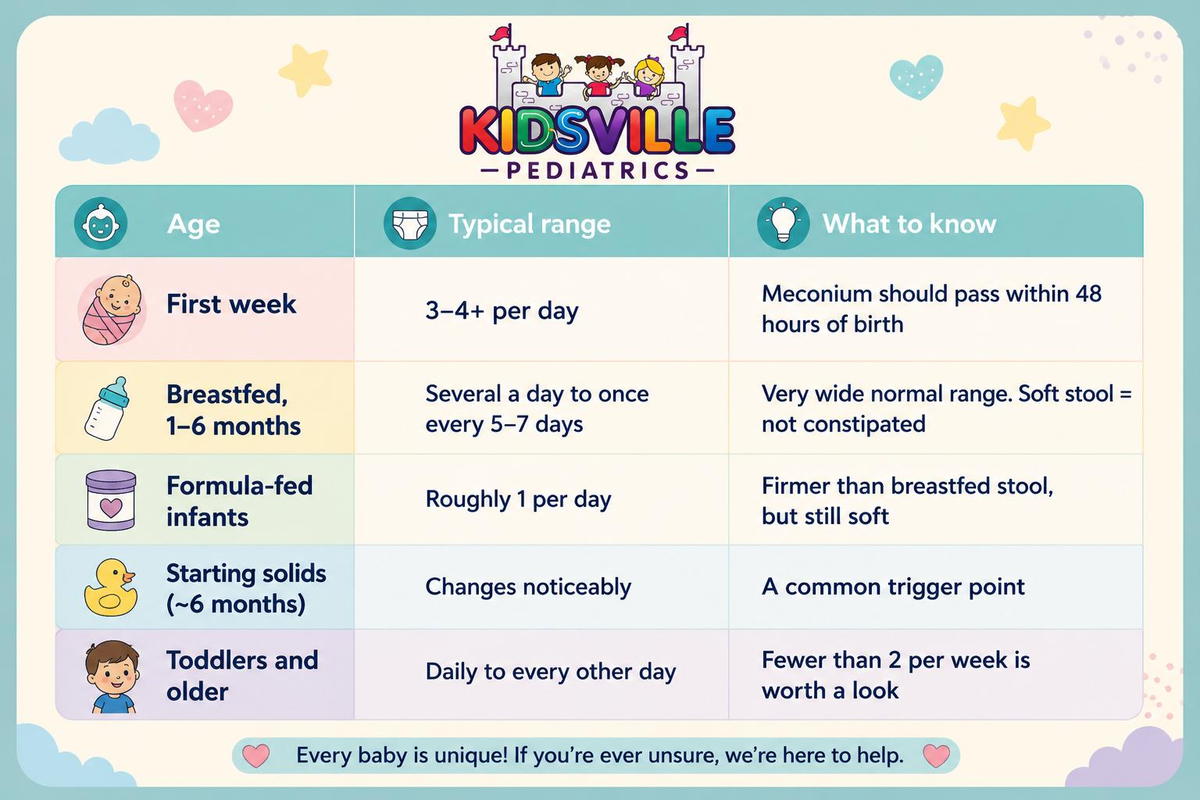
Four moments account for most of what we see: starting solids, the switch to cow’s milk around 12 months, toilet training, and the first weeks of school when kids start avoiding the bathroom away from home.
When should I worry about my toddler’s constipation?
Call the same day for any of these:
- A baby under 1 month who is constipated, or a newborn who didn’t pass meconium within 48 hours of birth
- Blood mixed through the stool — a small streak from a tear is common; blood mixed in is not
- Vomiting, especially if it’s green
- A swollen, firm, or very tender belly
- Fever with abdominal pain
- Weight loss or poor growth
- Soiling accidents in a child who was reliably toilet trained
- Thin, ribbon-like stools
- A dimple, tuft of hair, or other mark low on the back, or new weakness in the legs
Call, less urgently, if home measures haven’t worked after about a week, if your child is genuinely afraid of the toilet, or if this keeps coming back. Recurrence is the pattern most worth treating early — the longer the cycle runs, the longer it takes to unwind. Book Sick Visits & Same-Day Appointments in case of a problem.
What can I do at home for a constipated child?
Start here and give it a few days:
- Under 12 months: call before changing anything. The AAP advises no fruit juice before age 1 — but a pediatrician may specifically recommend a small daily amount of prune or pear juice for constipation. Don’t switch formulas, add cereal to bottles, or use corn syrup or honey on your own
- Over 12 months: cap cow’s milk at roughly 16–24 oz a day. Too much milk is one of the most common causes we find in toddlers, and one of the easiest to fix
- Fibre: a rough daily target is your child’s age plus 5 grams. Pears, prunes, peaches, plums, beans, and whole grains do more than a supplement will
- Water: fiber without fluid makes things worse, not better
- Sit routine: 5–10 minutes on the toilet after meals, when the body’s own reflex is already working. A footstool that brings the knees above the hips matters more than most parents expect
- Movement: bicycle legs and tummy time for babies; active play for older kids
Skip enemas, suppositories, mineral oil, and adult laxatives unless your pediatrician has specifically directed it.
Why does toilet training cause constipation?
Because of a loop that starts with one bad experience:
- A hard stool hurts
- Your child holds the next one to avoid the pain
- Held stool sits in the colon, water is reabsorbed, and it gets harder and larger
- The next one hurts more
None of that is a discipline problem, and pushing harder on training while the loop is running usually makes it worse. Soften the stool and treat the pain first; pause the pressure, keep the routine calm, and let training resume once going stops hurting. Praise the sitting, not the result.
The tell is retentive posturing — stiff legs, rocking on tiptoe, crossed ankles, clenching, hiding behind furniture. In our experience at Kidsville, parents describe this as their child “pushing so hard and nothing comes out.” It’s almost always a child working hard to hold it in, and recognizing the difference changes the whole plan.
Frequently asked questions
Is my newborn constipated if they grunt and strain?
Usually not. Babies under about 9 months often grunt, strain, turn red, and cry for 10–20 minutes before passing a soft stool. That’s coordination, not blockage — they haven’t yet learned to relax the pelvic floor while bearing down, and it resolves on its own. If the stool that finally arrives is hard and pellet-like, that’s a different situation and worth a call.
My potty-trained child is having accidents again. Is that constipation?
Often, yes — and it’s the version parents least expect. When a large mass of stool sits in the rectum, softer stool leaks around it and stains underwear through the day. It looks like regression or defiance. It’s overflow from a backup (encopresis), and children genuinely can’t feel it happening or stop it. It needs a clean-out plan from your pediatrician, not consequences at home.
Is MiraLAX safe for children?
Polyethylene glycol is a first-line treatment pediatricians prescribe often and have long experience with. What matters is that the amount is matched to your child’s weight and adjusted to their response over weeks — starting it without guidance is how families end up under- or over-treating for months. Ask us before you start, not after.
How long does it take to get better?
Longer than most families expect, and that’s normal. A stretched colon needs weeks to months of consistent, soft, painless stools before it regains normal tone and sensation. Stopping treatment as soon as things look better is the single most common reason constipation comes back — plan on a follow-up visit to decide together when to taper.
This article is general information based on AAP guidance and is not a substitute for individualized medical advice for your child. If your child has severe abdominal pain, persistent vomiting, blood in the stool, or a swollen belly, call our office or seek emergency care.
Talk to a Kidsville pediatrician
If your child is straining, holding, or having accidents, we can sort out what’s going on and get you a plan — usually in one visit. Book at kidsvillepeds.com/appointment, or call the office nearest you:
- Mansfield — (682) 341-3910
- Southlake — (682) 345-8010
- McKinney — (469) 885-9400


