
You’re handed a discharge folder, a car seat you’ve practiced buckling six times, and one instruction: call your pediatrician in the next two days. Then the hospital doors close behind you and it’s just the three of you.
Your newborn’s first office visit happens 24 to 48 hours after hospital discharge — usually day 3 to 5 of life. Expect a full weigh-in and head-to-toe exam, a jaundice check, a feeding assessment, review of hospital screening results, and Texas’s second newborn screen. Plan on 30 to 45 minutes.
When should my newborn’s first pediatrician visit be?

- Discharged after 48 hours in the hospital: within 2 to 3 days
- Discharged before 48 hours: within 2 days — the American Academy of Pediatrics is specific about this window
- Baby born early, jaundiced in the first 24 hours, or having trouble latching: sooner, sometimes the next morning
- Most Southlake families land on day 3 to 5 of life
The reason for the tight timeline is weight and bilirubin. Both move fast in the first week, and both are much easier to correct early than late. Babies discharged before 48 hours haven’t yet hit the point where jaundice typically peaks, which is why the AAP asks for eyes on them within two days (HealthyChildren.org — Jaundice in Newborns).
Call to book this appointment before you deliver, or from the hospital room. Newborn slots fill quickly, and you don’t want to be dialing on hold with a two-day-old.
What happens at your newborn’s first visit?
In order, roughly:
- Undressed weight, length, and head circumference. Plotted against birth weight and discharge weight
- Head-to-toe physical exam — soft spots, eyes, mouth and palate, heart and lungs, belly, hips, umbilical cord stump, reflexes, and circumcision healing if applicable
- Jaundice assessment, by exam and by a skin or blood bilirubin level if there’s any question
- Feeding review — breast milk, iron-fortified formula, or both; how often, how long, and how it’s actually going
- Diaper count. Wet and dirty diapers are the most reliable at-home proof that feeding is working
- Hospital screening results reviewed — the newborn blood spot screen and the hearing screen
- Texas’s second newborn screen, if it’s due
- Hepatitis B vaccine, if it wasn’t given in the hospital
- Vitamin D discussion — 400 IU daily for breastfed and partially breastfed babies
- Guidance and questions — safe sleep, cord care, bathing, how to take a rectal temperature, and how you as parents are doing
(Source: AAP 1st Week Checkup Checklist, 3 to 5 days old)
One item on that list surprises Texas parents more than the rest. Texas requires two newborn screens, not one — the first drawn in the hospital at 24 to 48 hours of age, the second at roughly 1 to 2 weeks. That second heel stick catches conditions the first screen can miss because the baby simply hadn’t been feeding long enough for them to show up, and it usually happens at an early pediatric visit rather than back at the hospital (Texas DSHS Newborn Screening Program).
What should I bring to my newborn’s first appointment?
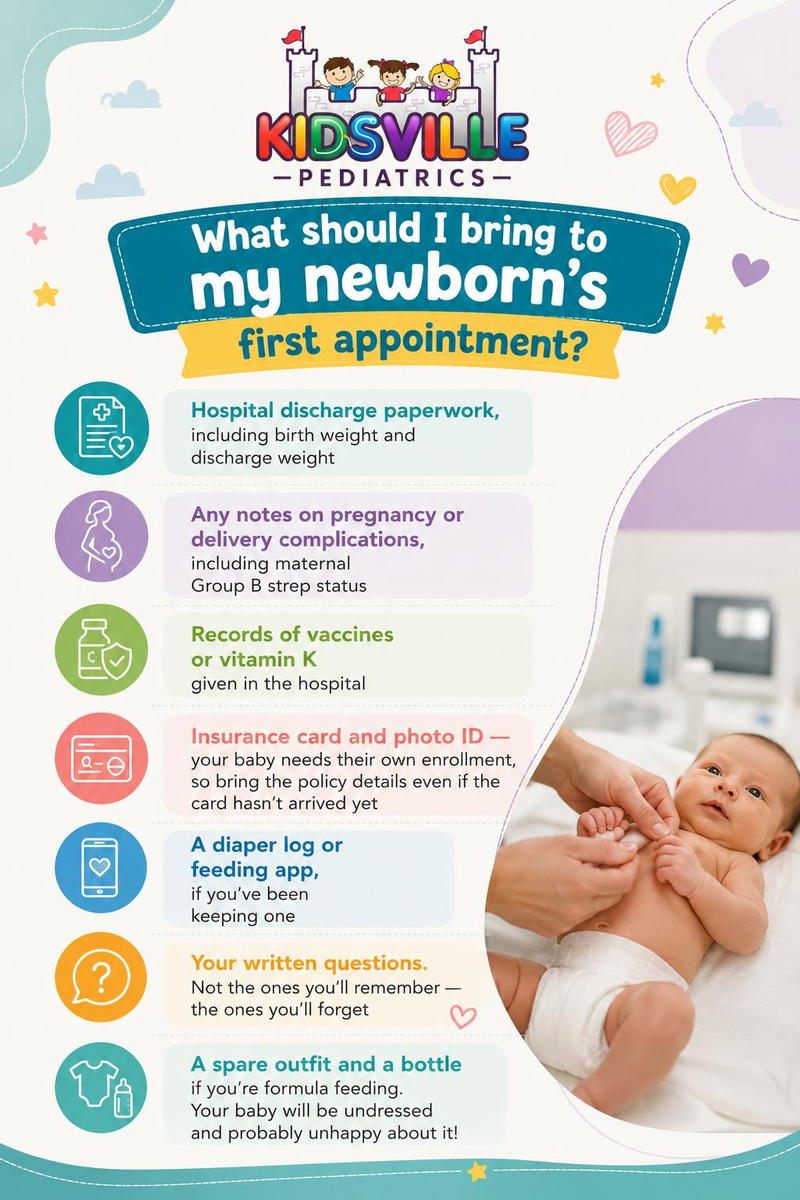
- Hospital discharge paperwork, including birth weight and discharge weight
- Any notes on pregnancy or delivery complications, including maternal Group B strep status
- Records of vaccines or vitamin K given in the hospital
- Insurance card and photo ID — your baby needs their own enrollment, so bring the policy details even if the card hasn’t arrived yet
- A diaper log or feeding app, if you’ve been keeping one
- Your written questions. Not the ones you’ll remember — the ones you’ll forget
- A spare outfit and a bottle if you’re formula feeding. Your baby will be undressed and probably unhappy about it
What do new parents ask us most at the first visit?
Is it normal for my baby to lose weight?
Yes. Most newborns lose weight in the first few days and are back to birth weight by about two weeks. What we’re watching for is the pattern, not a single number — a baby who has started climbing again by day 5 is on track even if the loss looked alarming on day 3. If weight is still dropping, we work on feeding mechanics before anything else.
How do I know if the jaundice is getting worse?
Call us if the yellow spreads down past the chest toward the belly and legs, if the whites of the eyes look yellow, or if your baby is hard to wake, unusually fussy, or feeding poorly. Most cases of jaundice require no treatment at all. When it does, it’s phototherapy — special lights, not sunlight. Placing a newborn in a sunny window is not a safe way to reduce bilirubin.
When should I call about a fever?
Any rectal temperature of 100.4°F (38°C) or higher in a baby under 2 months is a call-us-now situation, day or night. In our experience at Kidsville, this is the single most important number for new parents to memorise, because a newborn fever is evaluated urgently in a way a toddler’s fever isn’t. Use a rectal thermometer — it’s the most accurate method for a baby this young, and ear thermometers aren’t reliable under 6 months because the ear canal is too small (HealthyChildren.org — Fever and Your Baby).
Is the umbilical cord stump supposed to look like that?
Probably. Keep it dry, fold the diaper below it, and let it fall off on its own, usually within one to three weeks. Redness spreading onto the belly skin, pus, or a foul smell means call.
Can I meet the pediatrician before my baby is born?
Yes — and we’d encourage it. A prenatal consult lets you:
- Meet our clinical team and see the Southlake office before you’re doing it postpartum on three hours of sleep
- Confirm we’re in-network and understand the newborn billing setup
- Ask about our after-hours nurse line, same-day sick slots, and how we handle hospital follow-up
- Get your newborn’s first appointment on the books ahead of delivery
Parents frequently tell us the prenatal visit was the thing that made week one feel manageable. It costs you 20 minutes in the third trimester.
What well-child visits come after the first one?
- 3 to 5 days — the first visit
- 1 month
- 2, 4, and 6 months — the main vaccine visits
- 9 and 12 months
- 15, 18, 24, and 30 months
- Annually from age 3
Vaccines are timed to these visits, so keeping the well-visit calendar is most of what keeping the immunization schedule requires. You can see what’s given when on our Immunizations page.
This article is general information based on AAP and Texas DSHS guidance and is not a substitute for individualized medical advice for your baby. If your newborn has a rectal temperature of 100.4°F or higher, is difficult to wake, is refusing to feed, or looks deeply yellow, call our office or seek emergency care right away.
Book your newborn’s first visit in Southlake
Call our Southlake office at (682) 345-8010 to schedule your newborn’s first appointment — or a prenatal meet-and-greet if you’re still expecting. You can also book online at kidsvillepeds.com/appointment. Tell us your due date or discharge date and we’ll place you in the right window.


