
Vaccine Schedule Guide: What Each Shot Protects Against and When It’s Due
Your child’s immunization record fits on one card, and somehow it still takes a translator. DTaP, Hib, PCV, IPV — four abbreviations, four different diseases, four different due dates.
Children in the U.S. follow a schedule of about a dozen routine vaccines from birth through age 18. Most doses land at the 2-, 4-, 6-, 12-, and 15-month well visits, with boosters at 4–6 years and again at 11–12 years. Each shot is timed to the age when a child is most vulnerable to that specific disease — which is why the dates matter as much as the doses.
What is the child vaccine schedule by age?
Here is the full CDC-recommended schedule, birth through 18 years:
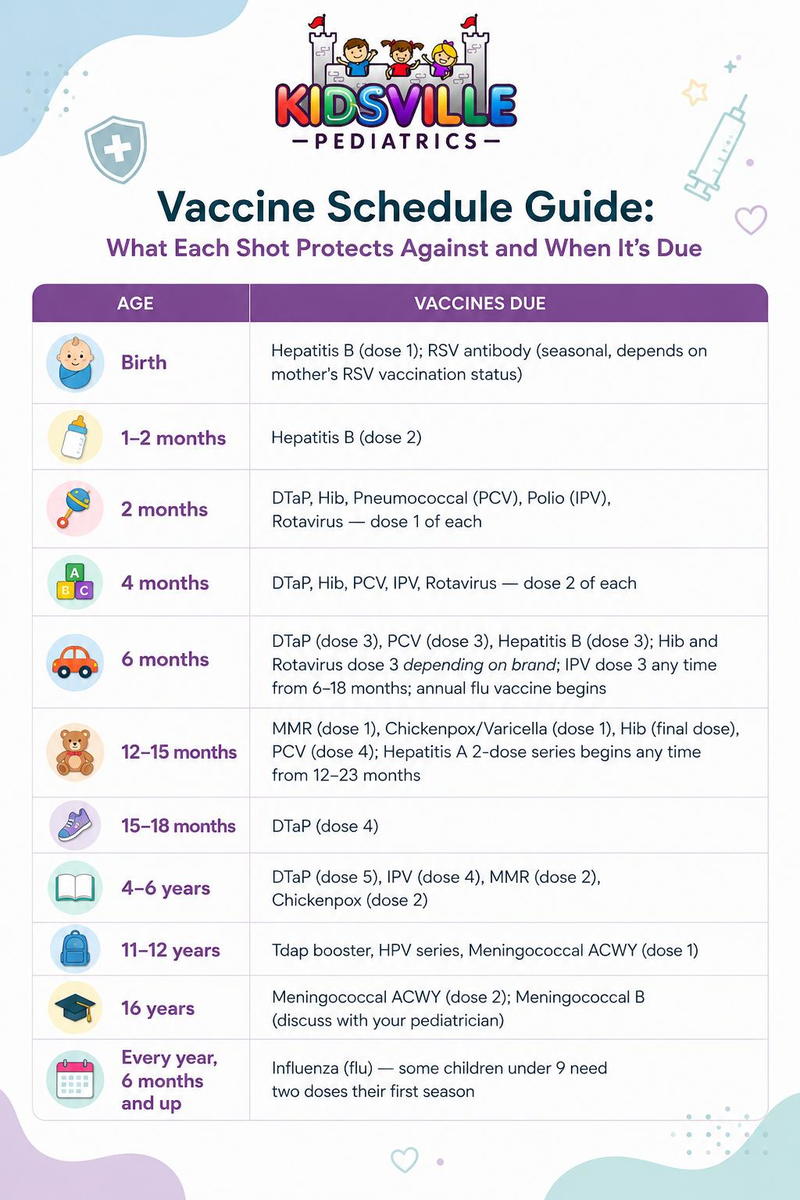
Three notes on this table. Ages are ranges, not deadlines — a 13-month MMR and a 15-month MMR are both on schedule. Rotavirus and Hib come in two or three doses depending on which brand your child received, so a “missing” 6-month dose is often not missing at all. And COVID-19 vaccination is now an individual decision made with your pediatrician rather than a fixed slot on the calendar, so it isn’t listed as a set dose above. (CDC child and adolescent immunization schedule)
What does each childhood vaccine protect against?
- Hepatitis B — a liver infection that becomes chronic in up to 90% of infants who catch it
- Rotavirus — severe infant diarrhoea and vomiting; before this vaccine existed, it was the leading cause of severe diarrhoea and dehydration in babies and young children. Given by mouth, not by needle
- DTaP — three diseases in one shot: diphtheria, tetanus (lockjaw), and pertussis (whooping cough)
- Hib — Haemophilus influenzae type b, once the leading cause of bacterial meningitis in young children
- PCV (pneumococcal) — pneumonia, meningitis, blood infections, and a meaningful share of ear infections (otitis media)
- IPV (polio) — paralytic polio
- MMR — measles, mumps, and rubella
- Varicella — chickenpox, including the severe skin and bloodstream infections that can follow it
- Hepatitis A — a liver infection spread through contaminated food and close contact
- Influenza — seasonal flu, which hospitalises thousands of U.S. children each year
- HPV — human papillomavirus, which causes cervical, throat, and several other cancers later in life
- Meningococcal (MenACWY, MenB) — bacterial meningitis and bloodstream infection, the illness that can go from headache to critical in under a day
Parents frequently ask us why the HPV vaccine is given at 11 or 12 years old, years before it seems relevant. The answer is immunology, not behaviour: the antibody response at that age is stronger than it is later, and a series started between ages 9 and 14 needs only two doses, while one started at 15 or older requires three. (CDC immunization schedule notes; AAP / HealthyChildren.org — Recommended Immunization Schedules)
Which vaccines does Texas require for school and child care?
Texas sets its own minimum requirements, and they are not identical to the CDC schedule:
- Child care and pre-K (by 43 months): 4 DTaP, 3 polio, 3 hepatitis B, 3 Hib, 4 PCV, 1 MMR, 1 varicella, 2 hepatitis A
- Kindergarten–6th grade: 4–5 DTaP, 3–4 polio, 2 MMR, 3 hepatitis B, 2 varicella, 2 hepatitis A
- 7th grade entry: a Tdap/Td booster received within the last five years, plus one dose of meningococcal MCV4 given on or after the 11th birthday — this is the pairing that catches families off guard the summer before junior high
- 8th–12th grade: the 3-dose tetanus/diphtheria primary series plus a booster within the last ten years, and the same one MCV4 dose on or after the 11th birthday. Meningococcal is required through 12th grade, not just at 7th grade entry
Dose counts vary with the age each series was started, so confirm your child’s specific gaps against the state chart: Texas DSHS vaccine requirements for school and child care.
What happens if my child misses a vaccine or falls behind?
Nothing has to start over. Catch-up is routine:
- No series restarts. Doses already given still count, however long ago they were
- Minimum intervals apply, not original ages. A catch-up schedule compresses the remaining doses using the shortest safe spacing between them
- A few doses expire rather than catch up. Rotavirus is the strict one: the first dose cannot be given at or after 15 weeks of age, and no dose can be given after 8 months. Hib and PCV series shorten or drop off entirely once a healthy child is past a certain age
- Several vaccines can be given at the same visit. Combining doses is safe and standard, and it means fewer trips for you
In our experience at Kidsville, families who have moved between states or changed practices are the most common catch-up cases — records scatter, not schedules. Bring whatever documentation you have, including a photo of an old shot card, and our clinical team will reconcile it against Texas ImmTrac and build the catch-up plan from there. You can review our approach on our Immunizations page.
Are the vaccines given all at once safe?
Yes. The specific concerns parents raise most often, answered directly:
- Does the immune system get overloaded? No. Today’s schedule protects against more diseases using fewer total immune-system targets than the schedule of the 1980s did, because modern vaccines are far more purified — the whole-cell pertussis vaccine alone contained thousands of components that the current acellular version does not (Offit et al., Pediatrics, 2002)
- What side effects are normal? Soreness at the injection site, fussiness, reduced appetite, and a low-grade fever for a day or two. A fever after the 12-month MMR often shows up 7–12 days later rather than the same night — that timing is expected, not a new illness
- What isn’t normal? Trouble breathing, hives, swelling of the face or throat, non-stop crying for hours, or a fever above 104°F. Call us
- Can we spread the shots out? Alternative schedules leave children unprotected for longer during the exact months they are most vulnerable, and they add visits without reducing risk. If you’re considering one, bring it up at the visit — that conversation is worth having in person rather than skipping doses quietly
When should we schedule vaccine visits?
Vaccines are given at routine well-child visits, so the schedule mostly takes care of itself if you keep those appointments:
- Newborn: 3–5 days, then 1, 2, 4, 6, 9, and 12 months
- Toddler: 15, 18, 24, and 30 months
- Age 3 and up: once a year
- Flu vaccine: every fall, ideally by the end of October
This article is general information based on the CDC and AAP immunization schedules and is not a substitute for individualized medical advice. Your child’s history, health conditions, and vaccination record may change what’s recommended. If your child has an urgent reaction or symptom after a vaccine, call our office or seek emergency care.
Ready to get your child caught up?
If you’re not sure where your child stands, bring the record to a well visit, and we’ll map it out with you — no judgment about gaps, just a plan. Schedule at kidsvillepeds.com/appointment, or call the office nearest you:
- Mansfield — (682) 341-3910
- Southlake — (682) 345-8010
- McKinney — (469) 885-9400
Reviewed against the CDC child and adolescent immunization schedule (last updated by the CDC July 2, 2025) in August 2026. We refresh this guide whenever a new schedule is published.
Tags:
Well-Child Visits,
Vaccine Schedule,
Childhood Immunizations,
CDC Vaccine Schedule,
Texas School Requirements,
Vaccine Catch-Up,
Pediatric Vaccines


