
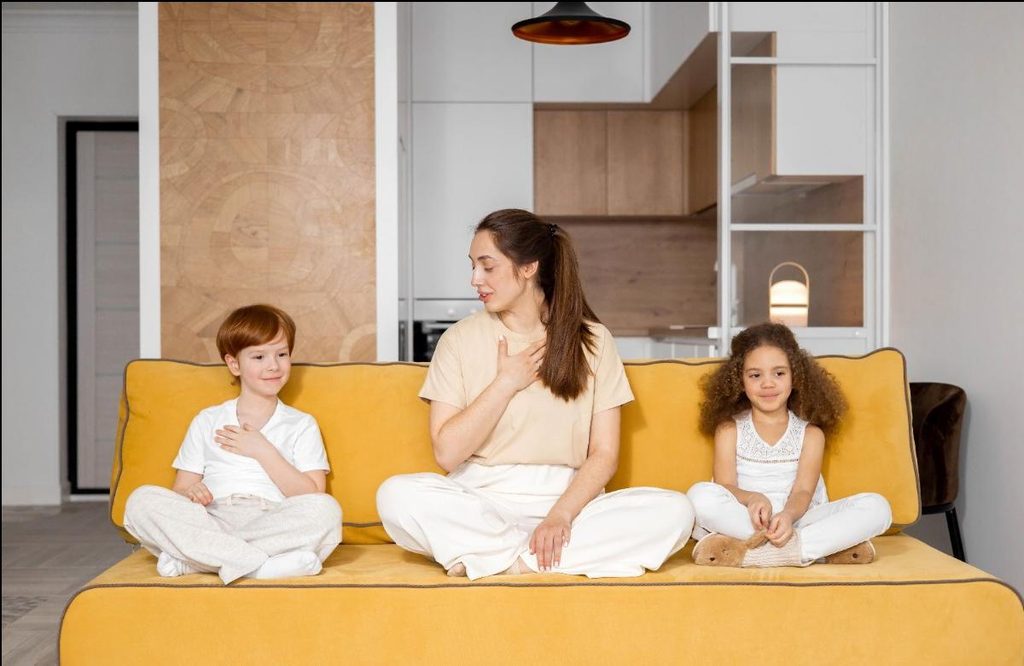
The 3-3-3 rule is a grounding exercise that asks an anxious child to name three things they can see, name three sounds they can hear, and then move three parts of their body. It interrupts a spiral of worried thinking by redirecting attention to the senses. It is a coping tool for everyday anxiety, not a treatment for an anxiety disorder.
Your eight-year-old is standing in the kitchen at 7:40 in the morning saying her stomach hurts, again, and the bus comes in four minutes. Nothing is wrong with her stomach. Something is wrong with the morning.
Plenty of parents meet the 3-3-3 rule on social media around this point and want to know whether it is real advice or just a reel. Here is what it is, how to use it, and where it stops being enough.
What is the 3-3-3 rule for anxiety?
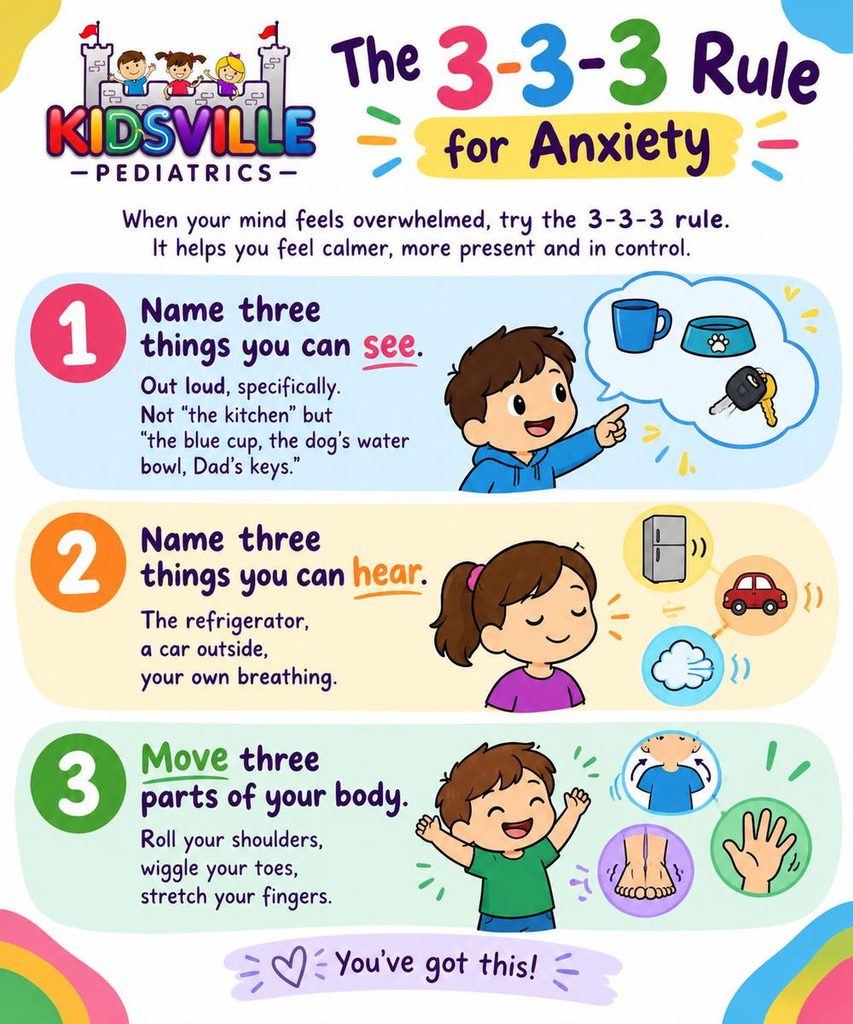
Three steps, in order:
- Name three things you can see. Out loud, specifically. Not “the kitchen” but “the blue cup, the dog’s water bowl, Dad’s keys.”
- Name three things you can hear—the refrigerator, a car outside, your own breathing.
- Move three parts of your body. Roll your shoulders, wiggle your toes, stretch your fingers.
Versions of this float around with small differences. Some swap the third step for three slow breaths, some add touch or smell. The variation matters far less than picking one version and using it every time, because a child in distress follows a familiar sequence much more easily than a new one.
The mechanism is simple. Anxiety pulls attention forward into what might happen, and naming what is physically in the room pulls it back to what is actually happening. Clinicians call this grounding, and versions of it appear inside cognitive behavioral therapy and trauma-informed care. The 3-3-3 packaging itself is popular shorthand rather than a protocol with its own research base, so treat it as a useful habit, not a clinical intervention.
How do you walk a child through the 3-3-3 rule?
Teach it when your child is calm. A new multi-step instruction delivered mid-meltdown usually fails, and failing at a coping skill makes a child less willing to try it again.
- Practice twice during a good moment, framed as a game: how fast can you find three red things?
- Let your child name it. “Three-three-three” works. So does “the looking game.”
- When anxiety shows up, do it with them rather than at them. Say the first one yourself.
- Keep your voice slow and flat. Children calibrate to adult tone far more than adult words.
- Do not require eye contact or stillness.
In our experience at Kidsville, the step parents skip is the practice run, and it is the step that decides whether the technique works at all. A child who has done it four times on a Saturday afternoon can reach for it on a Tuesday morning.
Afterward, resist the urge to debrief. Asking “do you feel better now?” invites a child to audit their own anxiety, which tends to bring it right back.
Does the 3-3-3 rule actually work?
For mild, short-lived anxiety, many children find it helpful, and it is free and portable. What it does not do is treat an anxiety disorder. Grounding manages a moment. It does not change the pattern underneath a child who has stopped going to birthday parties, who cries every Sunday night, or who has been to the school nurse eleven times this semester for a stomachache that resolves by lunch.
Parents sometimes tell us the technique “stopped working.” Usually the anxiety grew past what a coping skill alone can hold, which is information worth acting on rather than a sign that anyone did it wrong.
When does the 3-3-3 rule not help?
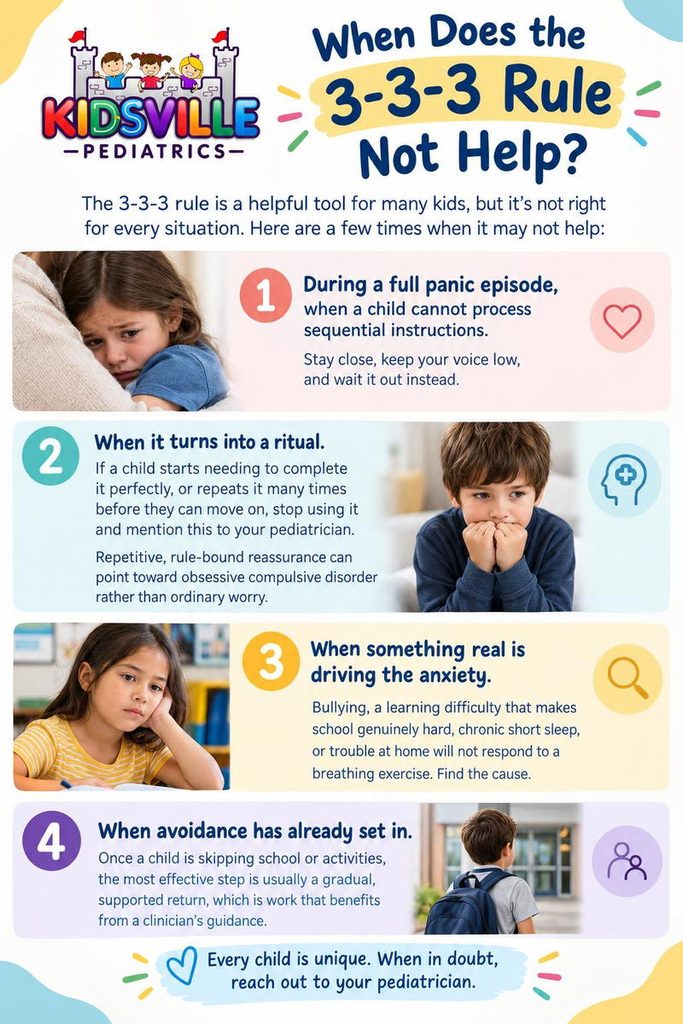
A few situations where it is the wrong tool:
- During a full panic episode, when a child cannot process sequential instructions. Stay close, keep your voice low, and wait it out instead.
- When it turns into a ritual. If a child starts needing to complete it perfectly, or repeats it many times before they can move on, stop using it and mention this to your pediatrician. Repetitive, rule-bound reassurance can point toward obsessive compulsive disorder rather than ordinary worry.
- When something real is driving the anxiety. Bullying, a learning difficulty that makes school genuinely hard, chronic short sleep, or trouble at home will not respond to a breathing exercise. Find the cause.
- When avoidance has already set in. Once a child is skipping school or activities, the most effective step is usually a gradual, supported return, which is work that benefits from a clinician’s guidance.
What else helps an anxious child at home?
- Protect sleep first. Short sleep amplifies anxiety, and it is the most fixable item on this list.
- Do not promise the feared thing will not happen. Say instead that they can handle it, and that you will be there afterward.
- Shrink accommodations slowly. Letting a child skip the sleepover feels kind and teaches avoidance. An hour beats not going.
- Keep mornings and bedtimes predictable. Routine does more for a worried child than any single conversation.
- Watch your own narration. Children borrow the risk level in a parent’s voice.
Anxiety shows up physically in children far more than in adults: stomachaches, headaches, trouble falling asleep, irritability that reads as defiance. If your child has had a workup for recurring stomach pain that came back clean, raise anxiety at the next visit.
Internal link: Book an appointment
When should I talk to a pediatrician about my child’s anxiety?
Bring it up at a visit when any of these are true:
- Worry has lasted more than a few weeks and is not easing
- Your child is avoiding school, friends, or activities they used to enjoy
- Sleep, appetite, or physical symptoms have changed
- The anxiety is disrupting family life or your child’s day at school
- You are managing it with accommodations that keep growing
- Your child talks about not wanting to be alive, or about hurting themselves
That last one is not a wait-for-the-next-visit item. Call us the same day. If you believe your child is in immediate danger, call or text 988 to reach the Suicide and Crisis Lifeline, available 24 hours a day, or go to the nearest emergency department.
At a visit, our pediatricians screen for anxiety, rule out medical causes for physical symptoms, and talk through what to try at home. When a child needs more than that, we refer to our partners at Harmonyville, a behavioral health practice with pediatric anxiety treatment and child and adolescent psychiatry in Mansfield and McKinney. Therapy, particularly cognitive behavioral therapy, is the usual first step for childhood anxiety, and most children do well with it.
Frequently asked questions
What age can a child start using the 3-3-3 rule?
Most children can follow it by around age five or six, once they can name objects on request and hold a three-step instruction. For toddlers, skip the counting: a hand on the back, a favorite blanket, or naming what you see together.
Is the 3-3-3 rule the same as the 5-4-3-2-1 technique?
They are the same idea at different lengths. The 5-4-3-2-1 version walks through five senses instead of three steps. Shorter is usually better for children, which is why 3-3-3 caught on. Use whichever one your child will actually finish.
Is this the same 3-3-3 rule people use for dogs or newborn sleep?
No. Several unrelated rules share the name, including one about adopted dogs settling in and one about infant sleep. The version in this article is a grounding exercise for anxiety.
This article is general educational information and is not a substitute for individualized assessment by your child’s pediatrician or a licensed mental health clinician. If your child is in crisis, call or text 988 or seek emergency care.
Talk to us about your child’s anxiety
If worry is interfering with your child’s sleep, school, or friendships, bring it to a visit. Our pediatricians take mental health concerns as seriously as a fever, and the sooner we look, the smaller the problem usually is.
Schedule at kidsvillepeds.com/appointment, or call the office nearest you:
- Mansfield: (682) 341-3910
- Southlake: (682) 345-8010
- McKinney: (469) 885-9400
Tags: Kidsville Pediatrics, Parenting Tips, Mansfield TX, Southlake TX, Child Anxiety, 3-3-3 Rule, Grounding Techniques, Coping Skills for Kids, Children’s Mental Health, Calming Strategies, Pediatric Wellness


